
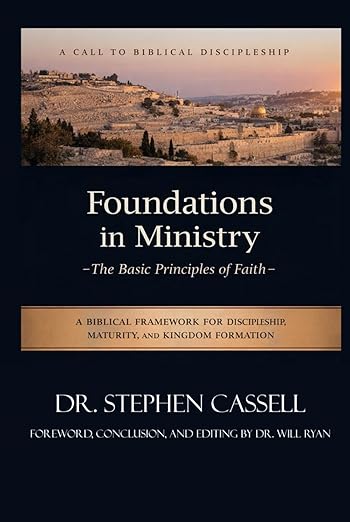
In an age marked by theological fragmentation, pastoral fatigue, and a growing hunger for authentic discipleship, the release of Foundations in Ministry: The Basic Principles of Faith arrives as both a timely contribution and a needed corrective. Published in March 2026 and spanning roughly 190 pages, the work seeks to recover what many in the modern church have inadvertently lost—namely, a coherent, embodied vision of faith that integrates belief, practice, and transformation.
At its core, this book is not merely an introduction to ministry concepts. It is an invitation to reconsider the very nature of Christian formation. Too often, contemporary Christianity has reduced faith to intellectual assent or emotional experience, while neglecting the deeper biblical vision of holistic restoration. Scripture, however, consistently frames salvation not as a disembodied transaction but as a participatory journey into wholeness—what the Hebrew tradition would call shalom, a restoration of the entire person within the covenantal life of God.
Beyond Information: Toward Formation
One of the central strengths of Foundations in Ministry is its implicit challenge to the modern tendency toward informational Christianity. The text calls readers back to a model in which theology is not merely studied but embodied. This aligns closely with the New Testament witness, where teaching (didachē) is inseparable from practice, and where the goal of instruction is not accumulation of knowledge but transformation into the likeness of Christ (cf. Romans 12:1–2).
In this sense, the book functions as a kind of reorientation. It invites readers to move beyond fragmented categories—doctrine here, spiritual disciplines there—and instead recover a unified vision of faith in which belief, healing, mission, and identity are deeply intertwined.
Healing as a Foundational Category
Though framed broadly around “principles of faith,” the deeper theological current running through the work is one of restoration. The biblical narrative itself begins in wholeness (Genesis 1–2), descends into fragmentation (Genesis 3), and moves steadily toward renewal through covenant, Messiah, and ultimately new creation (Revelation 21–22).
Within this framework, healing is not peripheral—it is central. Jesus’ ministry consistently embodies this reality. His proclamation of the kingdom is inseparable from acts of restoration: the blind see, the lame walk, the oppressed are freed. These are not random miracles but signs of a deeper reality—the inbreaking of God’s restorative reign.
Foundations in Ministry participates in this trajectory by re-centering faith not as abstract belief but as lived participation in God’s healing work. This is particularly significant in a cultural moment where many are disillusioned with forms of Christianity that speak of truth but fail to embody restoration.
A Needed Corrective to Reductionism
Another noteworthy contribution is the book’s resistance to reductionistic frameworks. Much of Western theology has, at times, narrowed the gospel to a singular mechanism—whether juridical, institutional, or purely individualistic. In contrast, this work gestures toward a more expansive vision: one in which salvation encompasses personal transformation, communal renewal, and participation in God’s broader redemptive purposes.
Such an approach resonates with the broader biblical-theological arc, where covenant, kingdom, and new creation are not competing themes but complementary dimensions of the same divine mission.
For the Church, Not Just the Academy
While the tone and structure are accessible, the implications are deeply theological. This is not a book written merely for academic consumption, nor is it a shallow devotional. It occupies a valuable middle space—one that equips pastors, leaders, and serious students of Scripture to rethink ministry from the ground up.
In particular, it serves as a resource for those who sense that something is missing in contemporary discipleship models. It provides a framework for rebuilding—one that is rooted in Scripture, attentive to formation, and oriented toward wholeness.
A Timely Contribution
The release of Foundations in Ministry: The Basic Principles of Faith should be seen not simply as the publication of another ministry resource, but as part of a larger conversation the Church must continue to have. What does it mean to be formed into the image of Christ? How do we move beyond fragmented expressions of faith into holistic restoration? And how might the Church once again become a place where healing—spiritual, emotional, relational, and even physical—is expected as a natural outworking of the kingdom?
These are not peripheral questions. They are central to the mission of God.
And it is precisely here that this book offers its greatest value—not by providing all the answers, but by reorienting the reader toward the right questions.
_____________________________________________________________________
About the Authors
Dr. Steve Cassell
Dr. Steve Cassell serves as a seasoned pastor, teacher, and shepherd whose ministry has been marked by a deep commitment to spiritual formation, biblical fidelity, and relational discipleship. With decades of pastoral experience, Dr. Cassell is known for his ability to bring theological clarity into the lived realities of the church, guiding individuals and communities toward maturity in Christ. His teaching emphasizes not only what believers are to know, but who they are becoming—men and women shaped by the presence of God, grounded in Scripture, and committed to the work of restoration within the body of Christ and beyond.
Dr. Will Ryan
Dr. Will Ryan is a theologian, educator, and ministry leader devoted to equipping the church through thoughtful biblical engagement and holistic formation. His work consistently integrates academic rigor with pastoral sensitivity, seeking to bridge the gap between theological reflection and everyday discipleship. Dr. Ryan’s passion lies in helping believers recover a robust vision of faith—one that encompasses healing, identity, mission, and participation in the life of God. Through teaching, writing, and ministry leadership, he continues to contribute to the renewal of the church’s understanding of what it means to follow Christ in both depth and practice.
 The King's Commission School of Divinity
Leave a comment