Ordination Through The King’s Commission School of Divinity
The King’s Commission School of Divinity (TKC) offers a structured pathway toward ordination for ministry for students actively enrolled in our programs. Students who have completed at least 50% of their academic coursework may be eligible to pursue ordination in partnership with their local church, ministry leadership, or denominational covering.
Our ordination process is designed to affirm both theological training and local church accountability, ensuring that candidates are equipped academically and recognized relationally within the body of Christ.
- Eligibility begins at the midpoint of your program
- Requires coordination with a local church or governing body
- Designed for pastoral, ministry, and leadership roles
- Ordination processing fee: $200
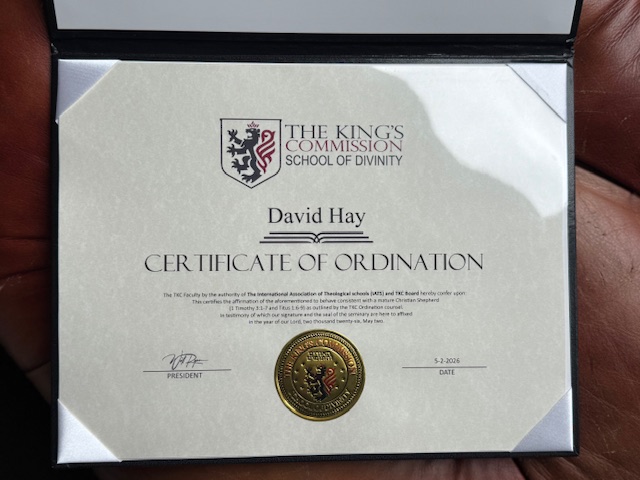
Ordination: A Biblical Pattern of Calling, Recognition, and Commission
Ordination is often misunderstood in the modern church—either reduced to a credential or elevated into something detached from the life of the body. Scripture presents something far more grounded. Ordination is not about status, but about recognition, responsibility, and participation in the work of God among His people.
A Pattern Rooted in Scripture
While the terminology varies, the pattern is consistent. In the Old Testament, individuals are set apart for specific roles through public recognition and divine initiative. Aaron and his sons are consecrated for priestly service (Exod 28–29), and Joshua is commissioned through the laying on of hands as Moses’ successor (Num 27:18–23).¹ This act is not merely symbolic; it represents both continuity of leadership and the empowerment of God’s Spirit (Deut 34:9).² This pattern carries forward into the New Testament. The early church recognizes and commissions leaders through prayer and the laying on of hands (Acts 6:6; 13:2–3).³ Paul’s instruction to Timothy further confirms this pattern, reminding him not to neglect the gift given “through prophecy with the laying on of hands” (1 Tim 4:14).⁴ Ordination, then, is not the origin of calling but the public affirmation of what God has already begun.
The Role of the Community
A defining feature of biblical ordination is its communal nature. Leadership is never self-appointed. The people of God discern, affirm, and participate in the recognition of those called to serve.⁵ This is evident in Acts 6, where the community identifies qualified individuals before the apostles lay hands on them.⁶ The act of ordination thus binds the individual to the community, establishing both accountability and shared mission. As John Goldingay has observed, Scripture consistently frames leadership within the context of communal identity rather than individual elevation.⁷ Ordination, rightly understood, is the church saying, “We recognize God’s work in you, and we stand with you in it.”
Authority as Stewardship
Biblical ordination does not grant independent authority. It entrusts responsibility under the lordship of Christ. Leadership is derivative, not autonomous. This is why ordination is consistently accompanied by prayer. The church acknowledges that the work ahead cannot be sustained by human ability alone. As Walter Brueggemann notes in his reflection on Israel’s leadership traditions, authority in Scripture is always tethered to divine dependence rather than personal power.⁸
Ordination, therefore, is as much an act of humility as it is of recognition.
Continuity and Flexibility
The New Testament does not present a single uniform ordination process. Instead, it reflects a consistent pattern expressed through varied contexts.⁹ This suggests that the early church prioritized faithful recognition and faithful sending over rigid institutional form.
What remains constant is the theological core:
- calling discerned
- community involved
- prayer offered
- leadership entrusted
As Craig Keener observes, the laying on of hands in early Christian communities functioned as both a symbolic and relational act of commissioning, linking individuals to the mission of the church.¹⁰
A Pastoral Reflection
For the church today, ordination should be understood not as a culmination, but as a beginning. It is not the completion of calling, but the formal acknowledgment of responsibility. It reminds us that Christ continues to lead His church by raising up servants—those who are called, formed, and entrusted for the sake of others. And it reminds those being ordained that their role is not to build something for themselves, but to faithfully steward what belongs to God. In a time when leadership can easily drift toward platform and influence, a biblical vision of ordination calls us back to something deeper:
A life marked by humility, accountability, and faithful service under the authority of Christ.
Notes (SBL Style)
- Gordon J. Wenham, Numbers: An Introduction and Commentary (Downers Grove, IL: IVP, 1981), 113–15.
- Peter C. Craigie, The Book of Deuteronomy (Grand Rapids: Eerdmans, 1976), 403–4.
- Craig S. Keener, Acts: An Exegetical Commentary, vol. 2 (Grand Rapids: Baker Academic, 2013), 1043–45.
- Philip H. Towner, The Letters to Timothy and Titus (Grand Rapids: Eerdmans, 2006), 312–14.
- Benjamin L. Merkle, 40 Questions About Elders and Deacons (Grand Rapids: Kregel, 2008), 205–6.
- Keener, Acts, 2:1040–42.
- John Goldingay, Old Testament Theology, Volume 3: Israel’s Life (Downers Grove, IL: IVP, 2009), 515–17.
- Walter Brueggemann, Theology of the Old Testament (Minneapolis: Fortress, 1997), 598–600.
- Andreas J. Köstenberger, Acts (Grand Rapids: Baker Academic, 2012), 199–201.
- Keener, Acts, 2:1043.

